Description
Caratteristiche tecniche
| Tipologia | 100 Corone |
|---|---|
| Material | Oro |
| Zecca | Vienna (MünzeOsterreich) |
| Peso effettivo | gr. 33,87 |
| contenuto | gr. 30,48 (0,9802 oncia troy) |
| Oro puro | 900% (21,6 carati) |
| Diameter | mm 37 |
| Periodo di coniazione | dal 1909 al 1914. Bisogna, però, ricordare che la moneta ancora oggi è sottoposta a riconio da parte della zecca ufficiale e reca al rovescio la data del 1915. |
Storia
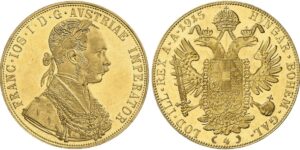
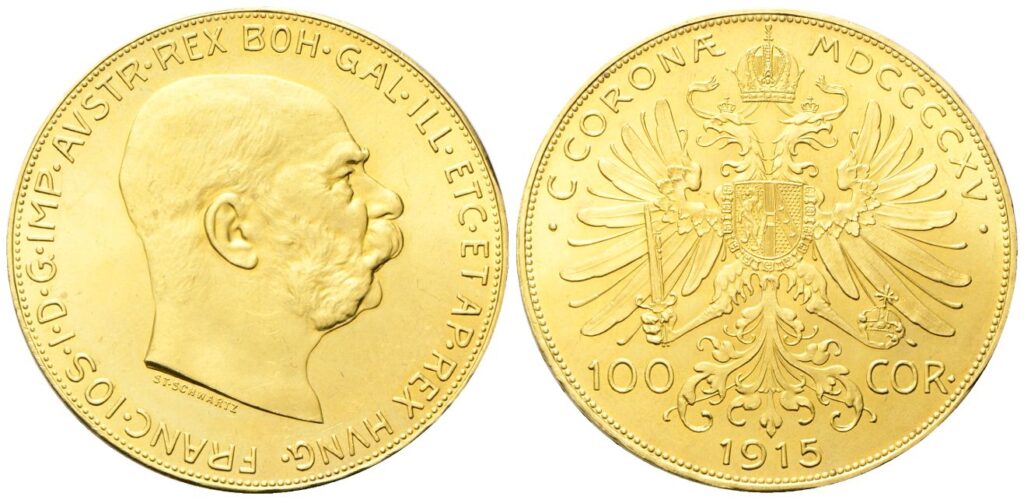
This beautiful coin, the austrian 100 crowns was coined for a few years, from 1909 to 1914.
As usual, currently, the austrian mint continues to coin this coin with a date of 1915.
The obverse features the portrait of Franz Joseph I, and on the edge the legend, the “FRANC•IOS•I•D•G•IMP•AUSTR•REX BOH•GAL•ILL•ETC•ET AP•REX HUNC”
The reverse, however, has the imperial coat of arms superimposed at the two-headed eagle and on the edge, there is the legend “C. CROWN MDCCCCXV” while the lower is the value and year (1915).
On board, there is the inscription in Latin Vnitis Viribvs, “With the Forces United”, which was the personal motto of Emperor Franz Joseph.
Le Corone d’oro sono un’ ottima forma di investimento per privati e/o istituzioni che desiderino investire in oro fisico.
Come per i 4 ducati, la particolarità è quella di essere una delle poche monete che non presenta il segno della zecca austriaca di Vienna (Münze Osterreich).
As well as the 4 gold ducats 1915, is a type of coin of great charm in the eyes of collectors because it represents a great historical period antecedent to our own: it is, for this reason, bought and traded, especially in the european regions of the former Austro-Hungarian Empire.
In Lombardy, the Trentino, Friuli Venezia Giulia and Veneto regions of italy where this coin, to important historical and cultural reasons, is exchanged between the various investors and lovers of the metal gold.
La Münze Österreich AG iniziò a coniare le Corone d’oro nel 1892, quando Francesco Giuseppe I ordinò una riforma monetaria. Le prime monete portavano valori di 10 e 20 corone. Nel 1908 seguirono le 100 Corone, per commemorare il giubileo di diamante dell’imperatore. La zecca austriaca ha cessato la produzione di monete d’oro dopo lo scoppio della prima guerra mondiale, nel 1918, data che coincide con lo scioglimento dell’Impero. Dopo la fine della Prima Guerra Mondiale, il Regno di Jugoslavia e la Cecoslovacchia furono i primi stati ad abolire la Corona austro-ungarica.
When the minting resumed in 1921, it was decided to the dating of the coins in 1915 to mark the last full year of the Emperor. Francesco Giuseppe I morì nel 1916, così per commemorare i suoi 68 anni di regno, tutti i riconi delle Corone dopo quella data sono ancora iscritti con l’anno 1915.
Fu così che in quello stesso anno la zecca d’Austria decise di riconiare le 100 Corone d’oro in segno di commemoration.
Per oltre cinquant’anni, le Corone austriache sono state una delle monete d’oro più diffuse sul mercato. Have been overcome by the Krugerrand south africancreated specifically for the market of private collectors. When the laws of the united states changed to allow private investment in monete d’orothe austrian mint increased production levels of the Crowns just to challenge the Krugerrand.
The Crown of the gold of Austria is coin investment very sought-after by collectors especially for her historical link with the past, which saw Austria-Hungary as one of the States most prevalent in Europe.
Video
[email protected]