Description
Caratteristiche tecniche
| Tipologia | 20 Dollari USA Saint Gaudens |
|---|---|
| Material | Oro |
| Zecca | Philadelphia, Denver, San Francisco |
| Peso effettivo | gr. 33,43 |
| contenuto | gr. 30 |
| Oro puro | 900 % (21,6 carati) |
| Diameter | mm 34 |
| Periodo di coniazione | dal 1907al 1933 |
A beautiful new series of coins american: this was the result of a dinner at the White House between the president, Theodore Roosevelt (1901-1909) and the famous sculptor Augustus St. Gaudens. In contrast to his predecessors, Roosevelt he was very interested in the aspect of national currencies, much to realize of the coins as beautiful as those of ancient Greece. St. Gaudens accepted the challenge and created a coin 20 dollars.
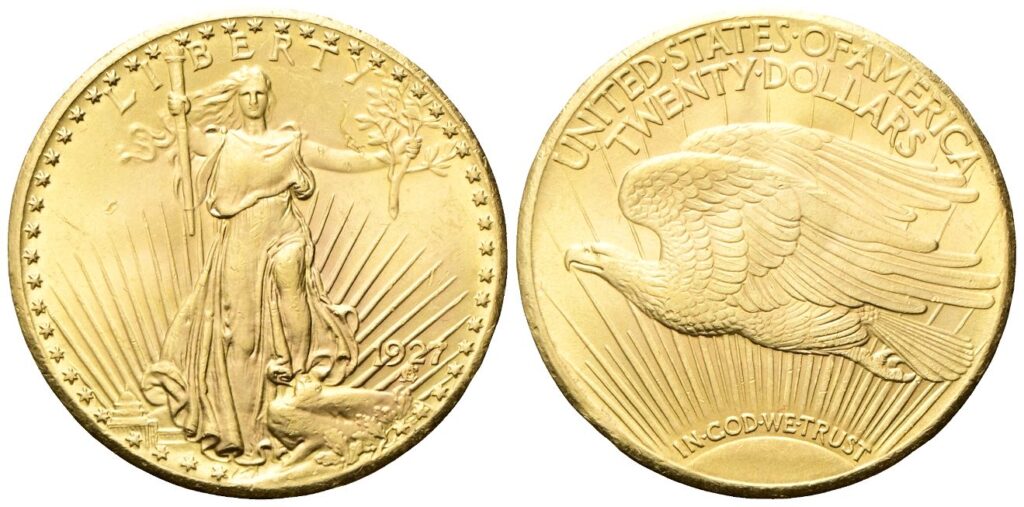
The obverse of this coin there is a figure of Liberty standing against the sun that rises on its back and the Capitol, second floor. Above his head is inscribed with the word LIBERTY. Dressed in a peplos floating, the Liberty holds a torch in her right hand and an olive branch in her left hand. His foot is resting on a rock.
Theodore Roosevelt The edge of the coin is surrounded by 64 star 5 tips.
In the field, to the right, it reads the date in roman numerals (MCMVII) below which are the initials of the engraver, ASG.
For the other dates, just the date is in Arabic numerals.
On the reverse, an eagle flies against the rays of the sun which appears at the bottom of the coin. While in the upper part of the figure, on two lines, the written UNITED STATES OF AMERICA – TWENTY DOLLARS.
Were produced twenty-two test samples in high relief, which has resulted in the use of the coin nine times; two of them were merged. Two of the remaining specimens are kept in the collection of the American Society of Numismatics. The Smithsonian Institution, and the Theodore Roosevelt Museum will have a copy each. Later, in 1907, 11 250 copies were produced with less marked reliefs and were put into circulation. These are the words E PLURIBUS UNUM (the national motto of the american). On the reverse, only 13 of the rays emerging from the sun, while on the test there are 14.
These coins met 5 emissions. They were accepted with enthusiasm, but the bankers and businessmen complained that difficult to stack.
To respond to these criticisms, prepare the new die axis or coin rotation for coins, $ 20 vintage in Arabic numerals and a raised less protruding. These were issued in 1907, and in the course of the following years. President Roosevelt, thought to be written with the name of God on a coin was blasphemous, and so the first issues drawn by St. Gaudens appeared without registration IN GOD WE TRUST that was on all of the gold coins of 5, 10 and 20 dollars manufactured from 1866 until 1907, without exception.
And’ the religious sentiment of the American instilled from the american civil War (1861-1865), which guided the choice of this motto. At the time of Theodore Roosevelt, the public, apparently, he was used to that, to see this written in the coins, because the protests were flocking to the Congress, which decided to enact the law (may 18, 1908), which provided that on all the coins of gold and silver appear to this motto. To comply with the law, Roosevelt decreed that the legend it would have appeared on the new coins: actually, in 1908, the writing appeared on the reverse of the coin, above the sun.
The a $ 20 St Gaudens has a diameter of 34 mm and weighs 33,4370 gr. with a title of 900 to 1,000, and a gold content up to 30,0933 gr.
Collezionare monete d’oro St. Gaudens Double Eagle è un’impresa piuttosto ambiziosa. Quando fu coniato per la prima volta nel 1907, il disegno originale era inciso in altorilievo; tuttavia, circa 11.250 di queste monete furono coniate prima che il design fosse modificato per consentire una produzione di formato poco profondo su presse per conio ad alta velocità. Notati e riconosciuti dal loro design con numeri romani MCMVII, i pezzi in altorilievo sono estremamente scarsi oggi e si stima che ne esistano ancora tra 2.000 e 3.000, il che rende la loro domanda piuttosto elevata.
Tra le St. Gaudens Double Eagles precedenti al 1933, ci sono una serie di rare emissioni ricercate da collezionisti e numismatici, in particolare quelle degli anni ’20. Ad esempio, il 1927-D è piuttosto difficile da acquisire. Nonostante ne siano stati coniati 180.000, ne esistono meno di una dozzina perché il resto non è stato rilasciato e fuso.
Tutti i St. Gauden emessi dopo il 1928 sono considerati rarità e, con l’ultimo anno di emissione nel 1933, c’è una storia piuttosto controversa. Come la versione 1927-D, la Double Eagle del 1933 ne aveva 445.000 in produzione; la stragrande maggioranza di queste monete fu fusa. Il governo degli Stati Uniti ha rilasciato una dichiarazione secondo cui nessun pezzo da 20 dollari del 1933 era stato ufficialmente rilasciato e che tutti quelli detenuti dai collezionisti erano stati rilasciati illegalmente.
Un’eccezione a questo status illegale fu una doppia aquila di Saint-Gaudens del 1933 che fu venduta nella collezione di re Farouk, che era re d’Egitto. Questa moneta doveva essere messa all’asta nel 1953 dopo che i beni del re furono sequestrati dal governo egiziano. Nel 2002 è stato venduto per $ 7.590.020. Ad oggi, quest’anno di emissione ha continuato a fare prezzi d’asta record ed è attualmente venduto in condizioni pari al nuovo per $ 18.872.250.
Con un numero romano aggiornato e altre quattro stelle per rappresentare gli attuali cinquanta stati che non esistevano nel 1907, la Zecca degli Stati Uniti ha resuscitato questa moneta d’oro Doppia Aquila nel 2009 in una moneta d’oro Doppia Aquila ad altorilievo, una moneta che non poteva essere realizzato con la tecnologia del 1907 e che prometteva di realizzare la visione di Augustus Saint-Gaudens.
Video
[email protected]