Description
Le 20 Lire d’oro, conosciute anche come Marenghi italiani, rappresentano una delle monete storiche più importanti del Regno d’Italia.
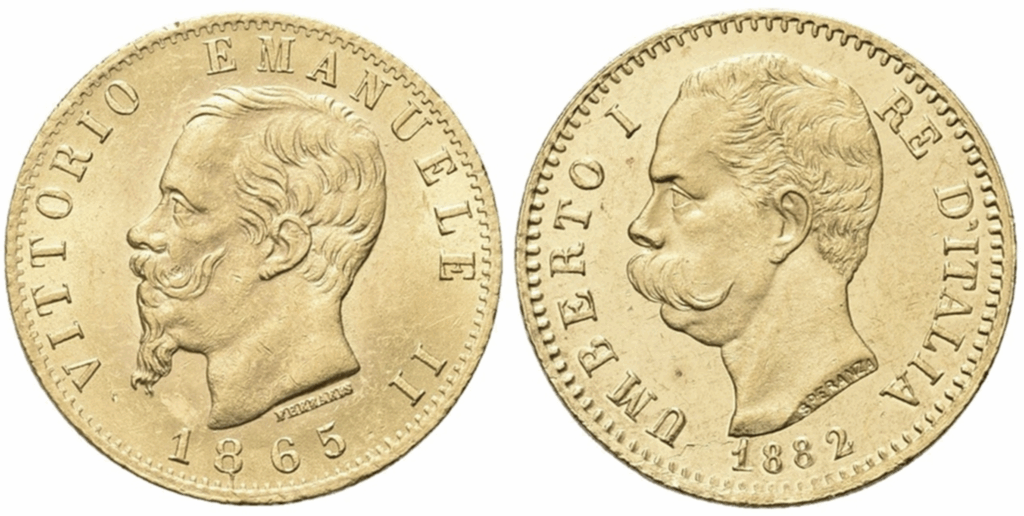
20 lire, or Marengo coined under Vittorio Emanuele II
Le 20 lire in oro a nome del primo re d’Italia furono coniate dal 1861 al 1878 e furono i primi marenghi d’oro ad essere diffusi in Italia per volontà di Vittorio Emanuele II.
Autore dei conii fu Giuseppe Ferraris che ritrasse sul dritto il re Vittorio Emanuele II a collo nudo, rivolto a sinistra (la firma Ferraris è in piccolo, sotto il collo) e circondato dal nome e dalla data di emissione in basso. Altrettanto classico il rovescio, con stemma sabaudo coronato e circondato dal collare dell’Annunziata, il tutto tra due rami di alloro; ai lati la dicitura “Regno d’Italia” e in basso il valore e i segni della zecca (T per Torino, M per Milano, R per Roma).
I Marenghi di Vittorio Emanuele II furono prodotti ininterrottamente fino al 1878, anno della dipartita del Sovrano. A causa dell’elevato numero di pezzi in circolazione, tranne alcune date, il loro valore è pari a quello dell’oro contenuto (5,80 gr.). Alcune date però sono di scarsa reperibilità per il basso numero di pezzi prodotti, pertanto possiedono un valore numismatico ben oltre quello dell’oro contenuto.
Le Zecche incaricate per la produzione di queste monete furono: dal 1861 al 1870 la zecca di Torino. Dal 1870 fino al 1878 le zecche di Roma e Milano. I segni di zecca riportati sul retro a fianco al millesimo sono: T (Torino), R (Roma) ed M (Milano).
Considered to be extremely rare, in 1873 the mint of Rome (from 2,000 to over 10,000 € for a perfect exemplar) and very rare 1870, Rome (from 800 to over 3,000 € for a perfect exemplar).
20 lire, or Marengo coined under Umberto I
The Marengo gold 20 Lire Umberto I changed compared to that of the previous king and the official mint-enabled its production was only that of Rome.
Umberto I, nicknamed the “kind King” of the House of Savoy is in the picture to the right of the coin, while the reverse side, in the upper part, between the two branches, there is the Stella d'italia (the symbol “country”, that is, the allegorical representation of italy). Outside of the crown, down to the hour of seven close to the edge, you will find the sign of the mint of Rome “R”. More externally, as with the straight, is this the pattern formed by a series of small cones. The edge of the coin is milled, and the axes are to the French.
I Marenghi italiani di Umberto I sono stati coniati in circa 8.763.000 esemplari negli anni: dal 1879 al 1886, 1888, 1889, 1890, 1891, 1893, 1897.
As often happens with any coin of value, even the Marenghi rare Umberto I have many fakes in circulation. They are basically identical copies, in terms of size, weight and fineness, to the original and put in circulation by the forgers of the time, and therefore devoid of value coin.
The most common of minting is the 1882, the year in which they did beat the gold coins, for a total of £. 139.523.000 (1.129 specimens from 100 lire, and the rest in “marenghi”) as there was a transformation of gold bars and coins in gold is not a decimal, the result of a loan of 644 million lire requested and received from the Italian government abroad, to cope with the conversion to the metallic currency of paper money, in the aftermath of the law (7.4.1881 nr. 133) that abolished the “circulation”. A circumstance that is certainly unusual, and that will not be repeated in the history of the country)
the justification for imposing the minting of gold coin from £ 20 with a specific one-thousandth, scrupulously reported in accordance with the article 11 of the Convention monetary latina.
The signing took place in London for work, especially of the lords of Baring Brothers & C., and C. J. Hambro & Sons (the Bank of Escompte of Paris vi figure for a small part) and Italy received the whole of the 644 million, of which 488 million in gold and 156 in silver scudi of the Latin League, yielding lire 36.487.250 income, 5 percent corresponding to the capital of lire 729.745.000.
Video
[email protected]